About Mixed Connective Tissue Disease
Mixed connective tissue disease (MCTD) is a systemic, autoimmune connective tissue disease.
- Features of lupus, rheumatoid arthritis, systemic sclerosis, and myositis, but it is a distinct entity
- Female predominance
- Peak incidence: 20 yo
- Systemic rheumatic disease with features of lupus, rheumatoid arthritis, systemic sclerosis, and myositis
- Raynaud’s phenomenon present in almost all patients (view image)
- Ribonucleoprotein (RNP) positivity is necessary for diagnosis:
- High-titer RNP=serological hallmark
- ANA positivity in almost all patients
- Pulmonary HTN: major cause of mortality
Most common features:
- Raynaud’s (~100%) (view image)
- Synovitis
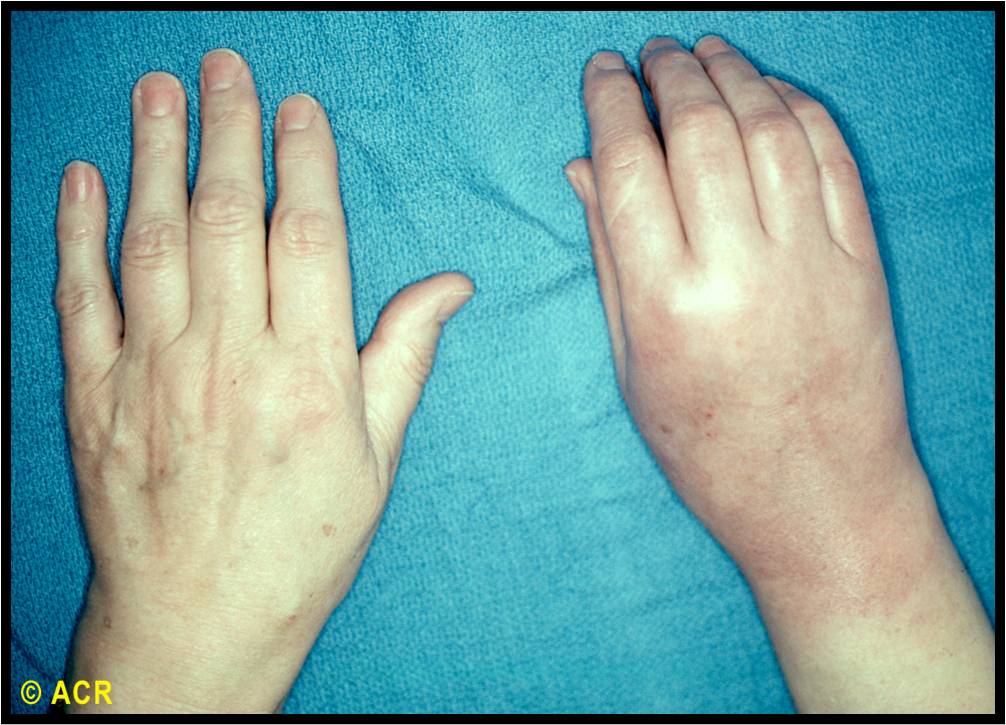
- Swollen hands, puffy fingers (view image)
- Myositis
Can also develop pulmonary, PAH, skin, and GI manifestations.
Typically develops gradually over time.
- Anti-ribonucleoprotein (RNP) antibody positivity is necessary for diagnosis
- Antinuclear antibody (ANA) positive in almost all (view image)
- If meets criteria of a different rheumatologic disease, consider overlap
- Abnormal nailfold capillaries (view image)
- Systemic lupus erythematosus
- Systemic sclerosis
- Idiopathic inflammatory myopathy
- Rheumatoid arthritis
- Primary Raynaud’s
- Idiopathic pulmonary hypertension
Treatment depends on disease manifestations and requires collaborative care.
Raynaud’s
- Calcium channel blockers
- Nitroglycerine
Arthritis
- Disease-modifying anti-rheumatic drugs (DMARDs)
Skin Manifestations
- Collaboration with dermatology
Can develop over time into another connective tissue disease.
Mortality is lower than systemic lupus erythematosus.
Systemic sclerosis-like manifestations typically cause the most long-term morbidity and mortality.
Pulmonary hypertension is the major cause of mortality.