Skip to content

From the American College of Rheumatology

Rheumatology for Primary Care
  • Symptoms
  • Diseases
    • ANCA-Associated Vasculitis
    • Behcet’s Syndrome
    • Chronic Recurrent Multifocal Osteomyelitis
    • Crystalline Arthropathies
    • Drug or Medication-induced Rheumatic Diseases
    • Giant Cell Arteritis
    • Henoch-Schönlein Purpura (HSP)
    • IgG4-Related Disease
    • Juvenile Dermatomyositis
    • Juvenile Idiopathic Arthritis
    • Kawasaki Disease
    • Mixed Connective Tissue Disease (MCTD)
    • Multisystem Inflammatory Syndrome in Children (MIS-C)
    • Myositis
    • Polyarteritis Nodosa
    • Polymyalgia Rheumatica
    • Rheumatoid Arthritis (RA)
    • Sarcoidosis
    • Sicca/Sjogren’s Disease
    • Spondyloarthritis
    • Systemic Lupus Erythematosus (SLE)
    • Systemic Sclerosis
  • Diagnostics
  • Case Studies
    • ANCA-Associated Vasculitis
    • Behcet’s Syndrome
    • Crystalline Arthropathies
    • Giant Cell Arteritis
    • Henoch-Schönlein Purpura
    • IgG4-Related Disease
    • Juvenile Dermatomyositis
    • Juvenile Inflammatory Arthritis
    • Kawasaki Disease
    • Mixed Connective Tissue Disease
    • Polyarteritis Nodosa
    • Polymalgia Rheumatica
    • Rheumatoid Arthritis
    • Sarcoidosis
    • Sicca/Sjogren’s Disease
    • Spondyloarthritis
    • Systemic Lupus Erythematosus
    • Systemic Sclerosis
  • Meds
    • Treatment Guides
    • Addressing Patient Fears
    • Treatment Considerations
    • Major Categories of Rheumatology Medications
  • Resources
    • Vaccination Considerations – Pediatrics
    • Vaccination Considerations – Adults

Polymalgia Rheumatica Case Studies

Home » Polymalgia Rheumatica Case Studies
Polymalgia Rheumatica Case Studies
  • Case 1

  • Case 2

  • Case 1

A 75 yo F with Hx of  DM2, HTN and OA presents with progressive stiffness originating in her shoulders and neck with more recent involvement of the bilateral lateral hips for 5 weeks. 

History

  • Symptoms present in the morning and improve with activity.
  • Acetaminophen provides minimal relief.

Physical Exam

  • Normal VS
  • Pain with palpation of shoulders and lateral hips, preserved strength
  • No evidence of swelling in small joints of hands and feet
  • 5/5 strength in upper and lower extremities

Diagnostic Workup

  • Labs: CRP 31 (H), ESR 75 (H), CBC with mild normocytic anemia, CMP wnl
  • Imaging: Shoulder x-ray with mild degenerative changes bilaterally
Diagnosis

Treatment

  • Prednisone 20mg per day resolved patient’s symptoms within 48 hours but blood sugar uncontrolled
  • Second line treatment: Patient started on SQ sarilumab with ability to taper off of steroids and without recurrence of PMR symptoms
  • Case 2

An 80 yo M with hx of HLD, CAD presents with new onset of unilateral headaches refractory to OTC medications including NSAIDs and acetaminophen. 

History

  • No vision changes
  • Few weeks of girdle stiffness
  • Symptoms of tiredness when chewing on food for long, such as food like steak

Physical Exam

  • Normal VS
  • Shoulders tender to palpation bilaterally
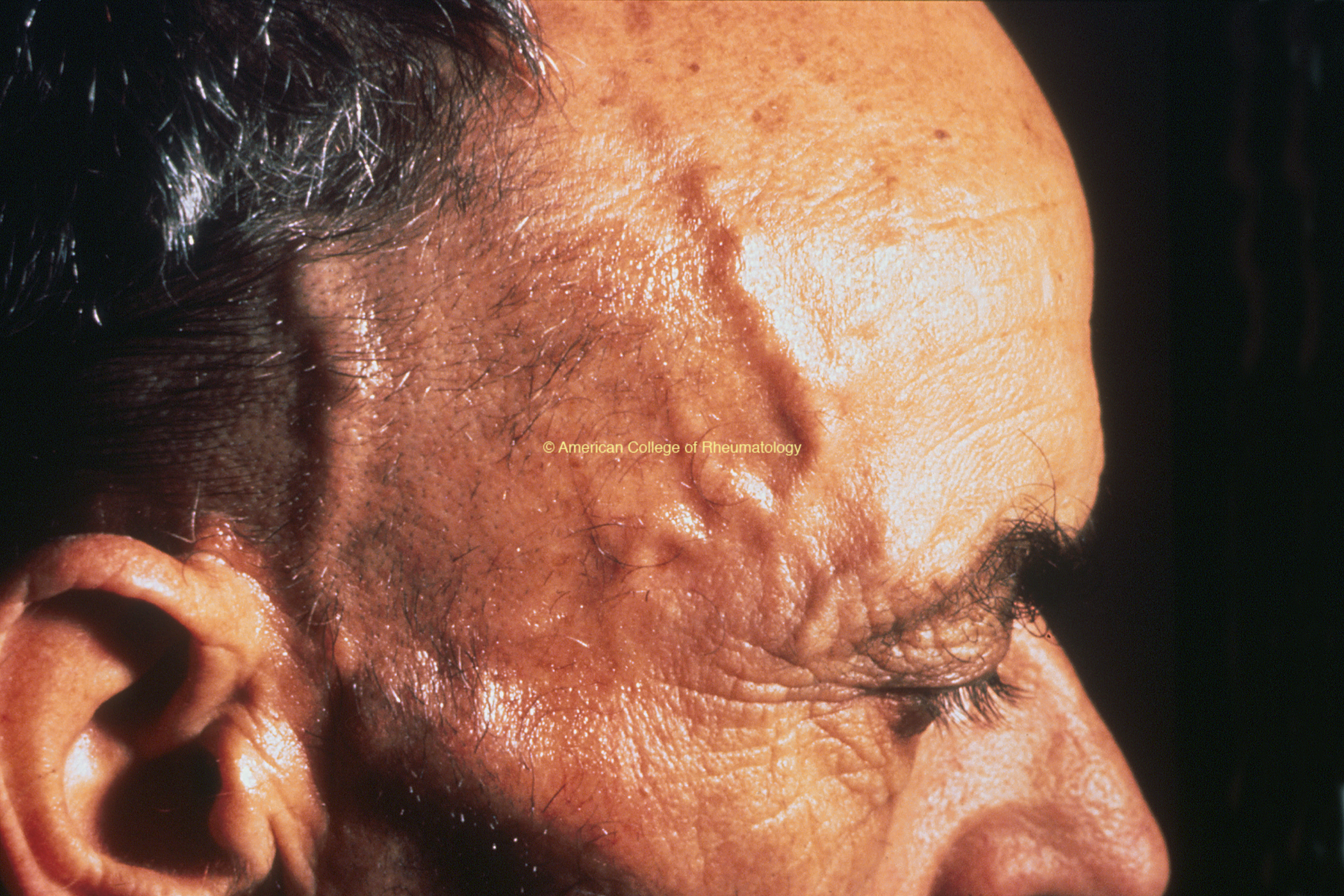
  • Scalp tender to palpation over the area of the temporal artery with diminished temporal artery pulse on right (view image)
  • High dose steroids started for high suspicion of giant cell arteritis.

Diagnostic Workup

  • Labs: CRP 50, ESR >120, CBC and CMP wnl
  • Biopsy:
    • Temporal artery biopsy pathology obtained within 2 weeks of steroid start.
    • Granulomatous inflammation of the inner half of the media, centered on the internal elastic lamina, with a mononuclear infiltrate, multinucleated giant cells, and fragmentation of the internal elastic lamina (view image)

Treatment

  • High doses of systemic steroids with improvement in headache
  • Also started tocilizumab to decrease steroid burden, given patient’s CAD 
Diagnosis

Based on the diagnostic workup and clinical presentation, the patient has polymalgia rheumatic.

Dilated Branches of Temporal Artery

Dilated branches of this temporal artery are seen. On palpation they were tender and indurated, but pulsations were still felt. These characteristic signs of swelling, tenderness, and inflammation may not always be present, even when biopsy results of the temporal artery are abnormal. In many patients, pulsations are absent in the affected arteries. Giant cell arteritis is frequently associated with headaches, jaw claudication, visual changes, and polymyalgia rheumatica. Wilske KR. Clinical spectrum of giant cell arteritis.
In: Internal Medicine for the Specialist. 1982;3(10):82-97. Healey LA. The Systemic Manifestations of Giant Cell Arteritis. New York, NY, Grune and Stratton; 1978.

Photomicrograph

This photomicrograph shows multiple giant cells lining up near the internal elastic lamina.

View Information About Polymalgia Rheumatica
Tami Bonnett-Admi2024-02-15T01:35:54+00:00

What do you think about this website?

We would love to hear your feedback.
Provide Feedback

Rheumatology Directory

Access this ACR resource to locate licensed rheumatology providers in your area for referrals.
Find A Rheumatology Provider

ACR Information

About ACR

ACR Contacts

Website Feedback

What do you think about the website? We would love to hear your feedback.

Provide Feedback

Authors

This product was funded by a medical grant from Pfizer. The content was written by a physician work group. See Authors.

© Copyright American College of Rheumatology 2026 | All rights reserved | See ACR Policies

Page load link
Go to Top